The Highly Questionable Historical Record of Pancho O’Malley
Compiled from the Lenihan Family Archive, Providence, Rhode Island
Donated to posterity by George Lenihan, 1990.
Lightly edited for brevity. Heavily edited for libel.
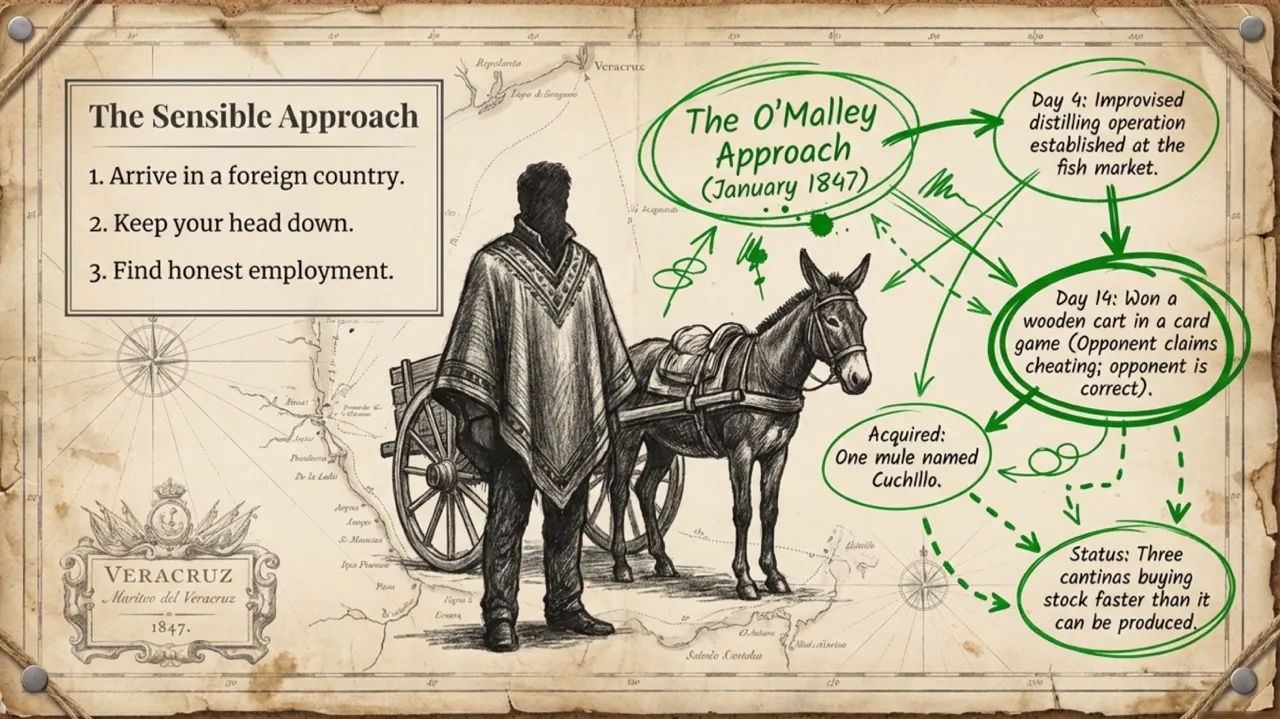
There are two kinds of men in this world: those who, upon arriving in a foreign country with nothing but a poncho, a wool coat, and an improvised distilling technique, sensibly keep their heads down and find honest employment — and Pancho O’Malley.
Within four days of docking in Veracruz, Pancho had set up a small operation on the edge of the fish market. Within a fortnight, the operation was no longer small. By the end of January, he had acquired a mule named Cuchillo, a wooden cart he’d won in a game of cards from a man who maintained — correctly, in retrospect — that Pancho had cheated, and a business arrangement with three separate cantinas.
The spirit itself had evolved since the Atlantic crossing. In Veracruz, Pancho had discovered that agave responded magnificently to the poitin technique. The result was something that was neither quite tequila nor quite poitin but emphatically, thrillingly, both — a drink that tasted, as Pancho himself described it, “like if Ireland and Mexico had an argument and both won.”1
Word spread the way things always spread in port towns: loudly, inaccurately, and at tremendous speed. It was the inaccuracy that caused the trouble. Someone in the chain of rumour had translated Pancho’s story of his Atlantic crossing and decided that the most important detail was his family’s historical connections to the Irish rebel cause and his personal acquaintance with, quote, “men of considerable military standing.”
The men of considerable military standing were, in reality, three farmers from Galway who had once thrown turnips at a British cavalry officer on a dare and then hidden in a ditch for six hours.2 This detail did not survive the translation.
What survived was the version in which Pancho O’Malley was a decorated veteran of the Irish Republican underground, personally commended by Daniel O’Connell, smuggler of weapons, outwitter of the British Empire, and a man with extensive contacts in the revolutionary movements of three continents.
Pancho, upon being told this was what people believed about him, paused for a long moment.
This was how he came to the attention of General Aurelio Vásquez de la Montaña.
The General was a man of magnificent ego and moderate military talent, stationed in Veracruz in the early weeks of the Mexican-American War, tasked with defending the city against the inevitable advance of General Winfield Scott’s American forces — a task he approached with elaborate confidence and very little in the way of a workable plan.3
His aide-de-camp, Lieutenant Rodrigo Fuentes — a young man of nervous disposition and extraordinary moustache — had heard about the Irish revolutionary veteran at the fish market and decided this was exactly the kind of foreign intelligence asset that could turn the tide of the war.
Pancho was brought to the General’s headquarters on a Wednesday afternoon, arriving on Cuchillo the mule, wearing his poncho over his wool coat, eating a tortilla, and telling a story to Lieutenant Fuentes about the time he had personally confused an entire British regiment in County Clare by moving all the road signs one night in a thunderstorm.
This story was completely fabricated. There were no road signs in County Clare in 1847 worth moving. There was barely a road.
The Lieutenant was rapt.
The interview lasted three hours. Pancho told the General about the rebel networks, the business of distilling under pressure, and the strategic technique he had personally devised — never before used in open warfare — of disorientating enemy forces through the systematic deployment of false information, decoy positions, and what he called “the geography of confusion.”
“I want you,” said the General, “to confuse the Americans.”
Pancho accepted. The General was offering, in addition to a commission of frankly astonishing vagueness, a military stipend, free accommodation, unrestricted access to the army’s provisions, and an official military letter of introduction that would allow Pancho to travel freely throughout Mexican territory without being stopped, questioned, or occasionally shot at by nervous sentries, which had been happening more than he would have liked.
What followed over the next several months was, by any measure, one of the more creative military careers in the history of the Mexican-American War — a conflict that has been extensively documented without any of those documents mentioning Pancho O’Malley once, which the Lenihan Family Archive maintains is a scandal of historiography.
Pancho’s method was simple. He would ride ahead of Mexican troop movements on Cuchillo, locate American scouting parties, and — rather than engaging in anything so pedestrian as combat — simply start talking.
He told them about treasure. Not ordinary treasure. The specific, highly detailed, historically-sourced treasure that only a man with Pancho’s gift could make believable — the legendary lost silver of a Spanish expedition from 1612, buried in a valley three days’ ride to the northwest. The story moved through the American forces with remarkable efficiency. At least two separate American companies spent the better part of a week searching a perfectly empty valley in the hills above Puebla, looking for a cave entrance described by Pancho as being “shaped somewhat like the face of a disappointed bishop.”5
They did not find the treasure. There was no treasure. There was no cave. There was certainly no bishop.
General Vásquez was delighted. He promoted Pancho to a rank that Lieutenant Fuentes translated as “Special Advisor of Strategic Misdirection,” which was not a rank that technically existed in the Mexican Army but which the General had invented specifically for the occasion and had printed on a very official-looking document with two separate seals.
Pancho had the document framed. He hung it above the cart where he kept his distilling equipment. Cuchillo, for his part, seemed unbothered by any of it. He was a very steady mule.
By autumn, the name Pancho O’Malley was being spoken in three languages across two armies. An American military dispatch described him, with notable agitation, as “an Irish agent of considerable cunning operating under Mexican auspices, whose activities have twice redirected our forward units and whose current whereabouts are unknown.”
His whereabouts, at the time of that dispatch, were in a cantina in a border town, three days’ ride north of Puebla. He was eating a bowl of something excellent and telling a story. His audience was in stitches.
But he was getting close.
— To be continued in Volume IV: The Cantina Plot —
1 The drink was eventually named by Bernardo the cook “O’Malley’s Mistake.” This was not intended as a criticism. Bernardo wept again when he tasted the first Veracruz batch. He still wouldn’t explain why.
2 The three farmers were Padraig Flannery, his brother Séamus Flannery, and a man known only as Big Declan. The British cavalry officer described the incident in his private journal as “undignified on all counts.” He was not wrong.
3 General Vásquez had, prior to the war, distinguished himself primarily by commissioning four portraits of himself and writing a very long memoir that stopped abruptly mid-sentence during an account of a horse fair in Guadalajara in 1831. The memoir was never continued. No one has ever successfully explained why.
5 The dispatch containing the cave description notes: “The cave entrance is described as resembling the face of a disappointed bishop, which I confess I found immediately recognisable, though I cannot now identify which bishop I had in mind.” Lieutenant Hargreaves appears to have been a man of unusual self-awareness.
Available for scholarly review by appointment, though appointments are rarely granted
and the archivist is very particular about biscuits.