The Highly Questionable Historical Record of Pancho O’Malley
Compiled from the Lenihan Family Archive, Providence, Rhode Island
Donated to posterity by George Lenihan, 1990.
Lightly edited for brevity. Heavily edited for libel.
By the end of the second week at sea, the crew of the Santa Catalina had developed what could only be described as a scheduling problem.
The problem was Sean O’Malley.
Not Sean himself — Sean was, by all accounts, delightful company. The problem was that the eleven men of the Santa Catalina had, in the course of fourteen evenings, heard every story Sean possessed, and they had begun requesting their favourites again. Captain Rodrigo had asked twice for the one about the devil and the cards. The cook, a compact and philosophical man named Bernardo, had become so attached to the tale of the three fishermen of Connemara and the talking salmon that he had begun re-enacting portions of it while preparing meals, to the mild alarm of everyone in the vicinity of the cooking pot.
The situation had, in the technical language of maritime affairs, gotten somewhat out of hand.1
But it was during the third week — on a Tuesday, though the Lenihan Family Archive is emphatic that the day of the week is not the point — that something happened which would change the course of Sean O’Malley’s life entirely, and incidentally the course of several historical events he had not yet been made aware of.
They ran out of tequila.
This was, among the crew of the Santa Catalina, considered a very serious matter. Captain Rodrigo had been running on a fixed tequila budget since Galway, and the budget had not accounted for the presence of an extremely sociable Irishman who, while not a heavy drinker himself, was the sort of person around whom other people inexplicably drank more. The last bottle was produced at dinner on the twenty-second day, passed around the table with the solemnity of a last rite, and emptied by the time the stars came out.
There followed a silence.
Sean looked at the empty bottle. He looked at the faces around him — eleven men of varying sizes and identical expressions of quiet desolation. He looked out at the black ocean. He looked back at the bottle.
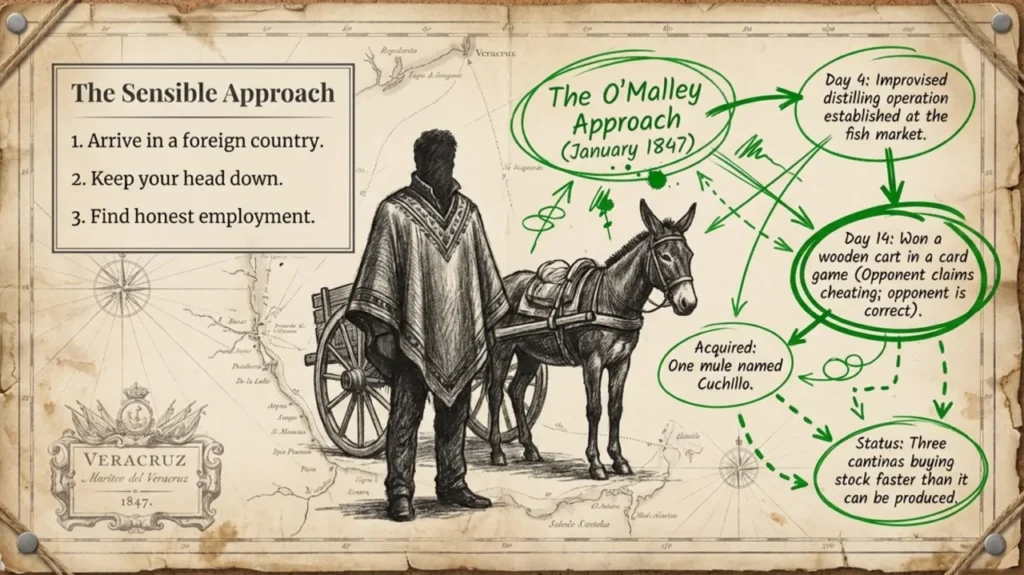
What followed over the next thirty-six hours has been described variously as “an act of genius,” “an act of lunacy,” and, in the account of First Mate Alejandro Ibáñez, “something I will never fully explain to my wife.”2 Sean O’Malley, drawing on knowledge acquired watching his father produce poitin in a shed behind their farmhouse in Galway — a shed which officially did not exist and had certainly never been raided by the constabulary on four separate occasions — improvised a distillation apparatus from materials available on a fishing trawler in the middle of the Atlantic Ocean.
The materials included: two cooking pots, a length of copper pipe that Bernardo had been meaning to repair for some time, a coil of rope used as insulation with mixed results, a sack of potatoes that the Santa Catalina had taken on in Bristol as partial payment from a merchant named Hodgkins who had run short of coin and long on root vegetables, and a great deal of optimism.
The result, produced on the morning of the twenty-fourth day, was a liquid of spectacular clarity and genuinely alarming potency. Captain Rodrigo tasted it first, as was his right as captain. He said nothing for approximately thirty seconds. Then he said something in Spanish that Sean did not understand but which First Mate Alejandro later translated, diplomatically, as “impressive.”3
The crew was in unanimous agreement. Whatever this was, it was extraordinary. It was unlike tequila. It was unlike anything any of them had ever encountered. It had, several of them noted, a quality of warming a man from the inside outward, as though his own blood had decided to be more enthusiastic about its job.
Bernardo wept quietly. He refused to explain why, but the general consensus was that he was moved.
By the time the Santa Catalina sailed into the port of Veracruz on a grey December morning, the reputation of the Irish distiller had preceded her. Three separate vessels had pulled alongside the Santa Catalina in the final days of the crossing, and each time Captain Rodrigo had charged them for the privilege of sampling a cup and split the proceeds with Sean, who by now had been given a hammock, a share of the fishing, and what he later described as “an informal but binding arrangement” with the crew.
It was in Veracruz, on the evening of their arrival, that the Ceremony took place.
Captain Rodrigo had convened the entire crew on the dock, which was unusual enough to attract a small audience of curious bystanders, dock workers, and one very old man who appeared to have been sleeping against a bollard and woke up in time to witness the whole affair.4
The Captain produced, from a trunk in his cabin, a garment that he explained had been given to him by his own grandfather — a poncho, a magnificent thing, woven in deep greens and golds with a pattern along the border that Bernardo said represented the sea, though others maintained it was mountains, and First Mate Alejandro thought it might be both.
The Captain placed it over Sean’s shoulders.
The fit was, it must be acknowledged, imperfect. Sean was narrower in the shoulder than the garment had anticipated, and taller by several inches than any previous owner. The poncho reached his calves in a manner that was either dramatic or slightly comic depending on one’s perspective. Sean pulled it around himself and stood very straight, which helped.
Captain Rodrigo addressed the crew and the assembled bystanders in Spanish — a speech which Sean did not follow in its particulars but which he understood in its general warmth — and First Mate Alejandro later summarised as: the Captain saying that this man had crossed the Atlantic on the wrong ship, fed them stories for three weeks and spirits for one, and had arrived in Mexico with nothing and made himself indispensable by the simple method of being absolutely impossible to dislike.
The dock was quiet for a moment.
Then the very old man who had been sleeping against the bollard began to clap.
And after a moment, so did everyone else.
Pancho O’Malley — and he would be Pancho O’Malley from that evening forward, in every document, conversation, and tall tale for the rest of his considerable life — stood on the dock in his oversized poncho and his wool coat and looked out at the warm Mexican evening, the torchlight on the water, the unfamiliar constellations overhead.
He had come to Mexico on the wrong boat. He had arrived with nothing. He had, in the space of twenty-four days at sea, become someone entirely new.
He decided this was, on balance, a considerable improvement on Boston.
And Pancho O’Malley always had another evening.
— To be continued in Volume III: The Mexican Army & Other Misunderstandings —
1 First Mate Alejandro Ibáñez notes that the scheduling problem was resolved by the democratic method of the crew voting on which story they wanted each evening, a system that worked well until the devil-and-cards story won four nights in a row, at which point Sean insisted on variety “for artistic reasons.”
2 The wife in question, a Señora Ibáñez of Veracruz, reportedly received a partial account from her husband upon his return and responded by asking only whether the Irishman was still aboard, and when informed he was not, said “pity” and returned to her sewing.
3 The Lenihan Family Archive contains a marginal note which reads: “Rodrigo said it tasted like God clearing his throat. Whether this is a compliment depends entirely on one’s theology.”
4 The old man is mentioned in three separate accounts of this event and in none of them does anyone know who he was. His precise role in the legend of Pancho O’Malley is therefore classified as Ambient and Important.
5 This phrase — “of everywhere” — was adopted by the Lenihan family as an unofficial motto for at least two generations, and appears on the inside cover of the Lenihan Family Archive in George Lenihan’s handwriting, beneath the note: “This is where we come from. All of it.”
Available for scholarly review by appointment, though appointments are rarely granted
and the archivist is very particular about biscuits.